If your first stop in Gyeongju is downtown or Bulguksa Temple and you’re watching your budget, the express bus is the better pick; if you’re continuing on to Busan afterward or traveling with heavy luggage, the KTX is worth the extra cost. The real difference between these three options isn’t just price and speed, it’s where each one actually drops you off, which changes how much extra time and money you need to add before you reach your actual stop in Gyeongju.
KTX from Seoul Station, KTX from Suseo, and express bus side by side
The two KTX departure stations and the express bus are laid out together below, with fare, travel time, and drop-off location checked against the operators’ own booking channels on 2026-10-24.

Seoul to Gyeongju. Verified 2026-10-31 from official sources.
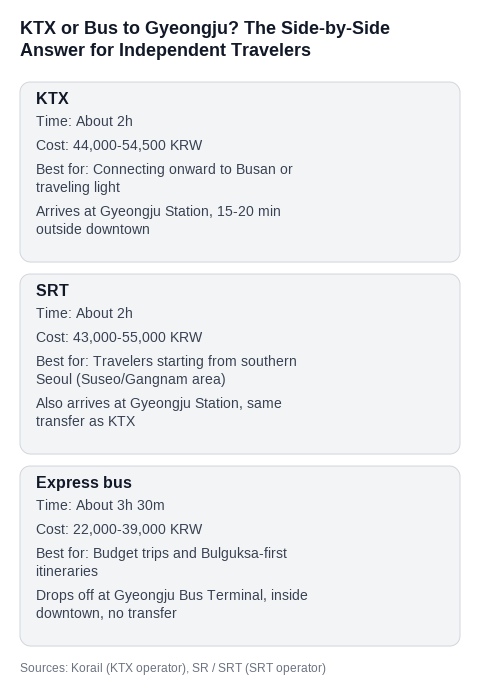
KTX or Bus to Gyeongju? The Side-by-Side Answer for Independent Travelers
| Mode | Travel time | One-way fare (standard/economy) | Where you’re dropped off |
|---|---|---|---|
| KTX from Seoul Station | About 2h-2h15m | 44,000-54,500 KRW | Gyeongju Station (Singyeongju until Dec 2023), 15-20 min outside downtown |
| KTX from Suseo (former SRT) | About 2h | 43,000-55,000 KRW | Gyeongju Station (same station) |
| Express bus | About 3h 30m | 22,000-39,000 KRW | Gyeongju Bus Terminal, inside downtown |
KTX trains leave from Seoul Station and from Suseo Station in southern Seoul, which matters if you’re staying near Gangnam. The Suseo trains ran as SRT until Korail merged that service into KTX on September 1, 2026, so both are now the same KTX ticket, booked together on korail.com or the Korail+ app. Both land at the same station outside the city, so the choice usually comes down to which departure station is closer to where you’re sleeping in Seoul, not to Gyeongju itself.
Why some older posts say ‘Singyeongju Station’
This is the part that trips up a lot of travelers searching this exact route. The high-speed station that KTX trains use sits about 12 km outside downtown. It opened in 2010 as Singyeongju Station and was officially renamed Gyeongju Station on December 28, 2023, so blog posts and map pins written before that date still call it Singyeongju. If you’re booking a KTX ticket now, search for ‘Gyeongju’; if an older article says ‘Singyeongju,’ it means the same station, not a second option. Either way, the station is outside the city center, and the last few kilometers into downtown are a separate leg.
The transfer the train fare doesn’t include
The KTX fares above get you to Gyeongju Station, not to the Bulguksa area, Gyeongju National Museum, or the downtown guesthouse district. From the station, a local city bus into downtown takes roughly 15-20 minutes and costs under 2,000 KRW with a T-money card; a taxi covers the same distance in about 15 minutes for somewhere around 15,000-20,000 KRW. Either way, add that time and cost on top of the train ticket when you’re comparing it against the bus, which puts you inside the city with no second leg. Our guide to using T-money on intercity buses covers whether the same card works for that connecting city bus.
Booking platforms and card issues
Korail’s English site (korail.com) takes international cards, and since the September 2026 merger it sells both Seoul Station and Suseo Station departures, but it has had scattered reports of payment failures on certain card networks or during 3D-secure checks, especially for cards issued outside Korea. If a booking attempt fails twice, switching to a third-party platform like Klook, which resells the same seat inventory, is usually faster than troubleshooting the card. Express buses book through Kobus (kobus.co.kr) or T-money BUS, and card acceptance there has been more consistently reported as working for foreign-issued cards, though seat selection in English is more limited than on the rail sites. If you haven’t booked a KTX ticket from Korea before, the step-by-step KTX booking guide for foreigners walks through the same booking flow used for the Gyeongju route.
Which one actually fits your trip
- Bulguksa or downtown Gyeongju is your first stop: take the bus. It lands inside the city, skipping the Gyeongju Station transfer entirely.
- You’re continuing on to Busan after Gyeongju: take the KTX. Trains from either Seoul Station or Suseo continue toward Busan on the same line, so you avoid backtracking into Seoul-side logistics and the time difference against the bus shrinks once you add the next leg.
- You’re traveling with heavy luggage or with kids: the bus’s one seat-to-seat ride, with no station transfer, is easier to manage than hauling bags through the Gyeongju Station connection, even though the ride itself is longer.
- You’re optimizing purely for cost: the bus is cheaper on the ticket alone, but recalculate after adding the station-to-downtown transfer cost for the train before assuming the gap is as large as the sticker prices suggest.
For the money side of this decision alongside the rest of a Korea trip, see our daily budget breakdown for independent travel in Korea, which places this transport cost in context with accommodation and food.
Last verified 2026-10-31. Prices, times and rules may change, so check the official sources before you travel.