Take Seoul Subway Line 4 one stop from Myeongdong Station to Chungmuro Station, transfer to Line 3, and ride it to Gyeongbokgung Station Exit 5 - but the exact path changes depending on which part of Myeongdong a trip actually starts from, since Myeongdong Station, Myeongdong Cathedral, and the middle of the Myeongdong shopping street sit near different subway lines.
The Route Depends on Exactly Where You Start in Myeongdong
Myeongdong is not one subway stop. It is a shopping district stretched between two separate stations on two separate lines, and that is the reason travel times for this trip are reported so differently from one source to another. The published numbers are not about a complicated route; they are describing different starting points and different paths through the same small area.
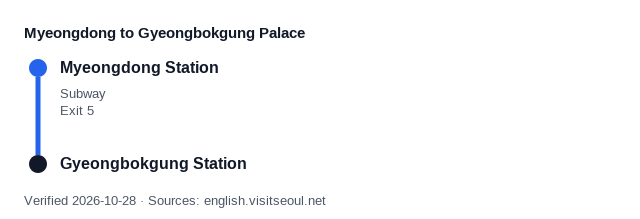
Myeongdong to Gyeongbokgung Palace. Verified 2026-10-28 from official sources.
- Starting at Myeongdong Station (Line 4, the station literally named Myeongdong): this is the route that goes through a transfer at Chungmuro Station, covered step by step below.
- Starting at Myeongdong Cathedral: the cathedral sits closer to Euljiro 3(sam)-ga Station than to Myeongdong Station. Euljiro 3(sam)-ga Station is already on Line 3, so a trip from the cathedral can board Line 3 directly and skip the Chungmuro transfer entirely.
- Starting from the middle of the Myeongdong shopping street: whichever entrance is closer, Myeongdong Station or Euljiro 3(sam)-ga Station, decides whether the trip needs the Chungmuro transfer at all. Checking a map for the nearest entrance before walking matters more than the subway route itself at this starting point.
Step by Step: Myeongdong Station to Gyeongbokgung Station (via Chungmuro)
This is the standard path for anyone starting at Myeongdong Station itself.
- From the Myeongdong Station platform, board a Line 4 train heading north toward Jinjeop (the direction away from Hoehyeon and Seoul Station) and ride one stop to Chungmuro Station. If the next stop announced is Hoehyeon, the train is going the wrong way: get off and cross to the opposite platform.
- At Chungmuro Station, follow the transfer signage for Line 3 toward the Daehwa/Ilsan direction and move to the Line 3 platform. This happens inside the paid area, so no extra ticket tap is needed.
- Board the Line 3 train heading toward Daehwa/Ilsan. The train passes through Euljiro 3(sam)-ga, Jongno 3-ga, and Anguk Stations before reaching Gyeongbokgung Station.
- Get off at Gyeongbokgung Station and follow the signs to Exit 5.
The Euljiro 3(sam)-ga Shortcut From Myeongdong Cathedral
Myeongdong Cathedral sits close enough to Euljiro 3(sam)-ga Station - an interchange between Line 2 and Line 3 - that walking there instead of to Myeongdong Station changes the route. Boarding Line 3 at Euljiro 3(sam)-ga Station in the Daehwa/Ilsan direction reaches Gyeongbokgung Station by passing directly through Jongno 3-ga and Anguk, with no need to change trains at all. For anyone whose starting point in Myeongdong is the cathedral rather than the subway station of the same name, this direct boarding is simpler than following directions written for Myeongdong Station.
Paying the Fare: One Combined Trip, Not Two
Seoul’s subway and bus fares increased on June 28, 2025, and the Seoul Metropolitan Government’s official fare notice, checked 2026-10-28, lists the current adult base fare (10 km or less) as 1,550 KRW when paid with a T-money or other transit card, or 1,650 KRW for a single-journey paper ticket bought with cash.
Because the Myeongdong-to-Gyeongbokgung trip stays inside the subway’s integrated, distance-based fare system even when changing from Line 4 to Line 3 at Chungmuro, the whole trip is billed as one combined fare rather than two separate base fares. A traveler using a T-money card pays the same 1,550 KRW whether the trip needs the Chungmuro transfer or goes directly from Euljiro 3(sam)-ga Station.
For two adults travelling together with T-money cards, the one-way cost works out to 2 x 1,550 KRW = 3,100 KRW total. Travelers who have not yet set up a transit card can read about buying and topping up a T-money card and how it compares to other transit card options.
Which Exit at Gyeongbokgung Station - and the Anguk Station Alternative
Gyeongbokgung Station’s Exit 5 leads toward the palace’s west side, near the National Palace Museum of Korea and Gwanghwamun, and it is the exit that matches the route described above.
Anguk Station, the stop immediately before Gyeongbokgung Station coming from Chungmuro, is a usable alternative when the actual destination is the palace’s east side, Gwanghwamun Square, Insadong, or Bukchon Hanok Village. Getting off one stop early at Anguk means a longer walk to the palace’s main south gate, but it can be the shorter walk if Bukchon or Insadong is the real destination for the day.
Walking, Bus, and Taxi Alternatives
The distance from Myeongdong to Gyeongbokgung Palace is roughly two kilometers through downtown Seoul, passing near Jogyesa Temple and Insadong, so walking the whole way is possible for travelers who enjoy a city walk and have time to spare. City buses also run through this corridor, and when a city bus beats the subway depends on the specific stop pair and time of day. A taxi is the fastest door-to-door option and is not expensive for this short a distance, though it costs more than the subway fare; booking a taxi in Seoul as a foreigner covers the app setup needed to do this smoothly. For real-time routing on the day of travel, checking whether Google Maps works for Korean public transit is worth doing before leaving the hotel.
Practical Notes Before the Trip
Gyeongbokgung Palace charges an adult admission fee of 3,000 KRW and is closed on Tuesdays (per the Korea Tourism Organization’s palace page, checked 2026-11-15). Free or reduced entry depends on age, and the age bands for foreign visitors are not always the same as for Korean nationals, so check the Korea Heritage Service’s official palace site rather than assuming a child or senior enters free. Opening hours are seasonal, running from 9:00 AM with a closing time between 5:00 PM and 6:30 PM depending on the month, so checking the current month’s hours before heading over is worthwhile. Travelers timing their visit around the guard-changing ceremony should also check that schedule separately, since it runs on its own timetable rather than the palace’s general opening hours.
Last verified 2026-11-15. Prices, times and rules may change, so check the official sources before you travel.