The cheapest way from Kansai Airport to Osaka is a commuter-type train: the Nankai Airport Express to Namba, or the JR Airport Rapid toward Tennoji and Osaka Station. Faster limited expresses and buses cost more, and which one is worth it depends on where you are sleeping, what time you land, and how much luggage you are pulling. This guide checked its timings against japan-guide.com on 2026-11-14 and sends you to official pages for money amounts, because fares change and are easy to misquote.
Start with your destination, not the price
Osaka has three common arrival areas, and each lines up with a different operator. Picking the line that ends closest to your hotel usually saves more time and stress than shaving the fare.
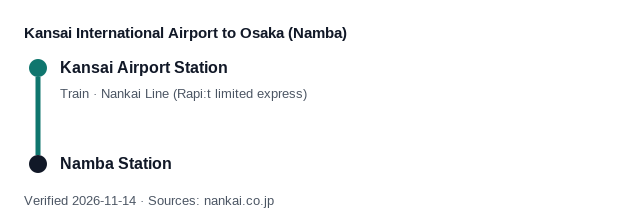
Kansai International Airport to Osaka (Namba). Verified 2026-11-14 from official sources.
Staying near Namba (Dotonbori, Shinsaibashi)
Nankai trains run from the airport straight to Namba station. The Airport Express takes about 45-50 minutes, runs about every 15 minutes, has no seat reservations, and can be crowded at rush hour. The Rapi:t limited express takes about 35-40 minutes, runs about every 30 minutes, and every seat is reserved. For Namba, the Airport Express is the cheaper rail choice and Rapi:t is the faster, more comfortable one. Fares for both are on Nankai’s official fare page.
Staying near Osaka Station and Umeda
The Umeda area sits around Osaka Station. JR serves it two ways: the Haruka limited express takes about 45 minutes, while the JR Airport Rapid takes about 70 minutes and costs less. Limousine buses also run to central Osaka, including a stop at Osaka Station. If your hotel is here, the Rapid is the budget pick and Haruka is the time-saving pick. Check JR West’s official fare page for current amounts.
Staying near Shin-Osaka (bullet train station)
Haruka runs to Shin-Osaka in about 50 minutes with reserved and unreserved seats. If you are catching a Shinkansen the same day or sleeping near the station, this is the simplest ride because it needs no transfer. Always confirm the current fare on JR West’s official page.
Compare the options side by side
Times below come from japan-guide.com (checked 2026-11-14). Money amounts are deliberately left to the operators’ official fare pages.
| Option | Goes to | Time | Seats | Frequency |
|---|---|---|---|---|
| Nankai Airport Express | Namba | about 45-50 min | Unreserved only | about every 15 min |
| Nankai Rapi:t | Namba | about 35-40 min | All reserved | about every 30 min |
| JR Haruka | Tennoji / Osaka Station / Shin-Osaka | about 30 / 45 / 50 min | Reserved or unreserved | about every 30 min |
| JR Airport Rapid | Tennoji / Osaka | about 50 / 70 min | Unreserved | about every 15 min |
| Limousine bus | Central Osaka incl. Namba, Osaka Station | about 45-60 min | Check operator | Frequent |
Do you need to reserve?
Only Rapi:t makes a seat ticket mandatory. The Airport Express has no seat reservations, and Haruka lets you choose between reserved and unreserved seats. In practice that means the cheapest trains need no planning, while the faster ones are worth buying once you know your landing time. If you are also adding a Korea leg, check a SIM or eSIM plan that covers both Korea and Japan so you can look up timetables the moment you land.
Landing late at night or very early
Late arrivals change the answer, because the cheapest option may no longer be running. According to japan-guide.com, the last train to Namba leaves just before midnight, while the last trains to Osaka Station and Kyoto leave around 11pm. Most last buses leave around 23:00 or midnight. First trains from Osaka reach the airport around 6:00, and early buses generally start arriving around that time too.
If your flight lands after about 22:00, build in time for immigration and baggage, then assume you may miss the last train. Your realistic fallbacks are a taxi to central Osaka, which takes roughly 50 minutes and costs far more than any train, or a hotel next to the airport followed by a morning train. japan-guide.com mentions hotels adjacent to Terminal 1, such as Hotel Nikko Kansai Airport and First Cabin. For a sense of how late-night transport works in Seoul, the same planning habit applies: know the last departure before you book the flight.
Big suitcases and family travel
Luggage changes which option is practical. Rapi:t has every seat reserved, so you board knowing you have a seat, which matters when you are managing several bags and children. Commuter trains such as the Airport Express and Airport Rapid can be crowded at rush hour, so luggage space and finding seats together are less certain. A limousine bus can reduce transfers because it runs directly to central Osaka stops, although you still carry bags from the stop to your hotel.
Before you commit, look up the station you will arrive at and your hotel’s nearest exit on the operator’s official station or accessibility page, since elevator and escalator layouts differ by station and were not verified here. If you are traveling with a family and a lot of bags, the safest low-effort combination is a reserved Rapi:t to Namba or a limousine bus, and then a short taxi from the stop if your hotel is not at the terminal.
IC cards and paying
This guide did not verify whether IC cards work for each service, so check the operators’ official pages before relying on one. If you want to see how Japan and Korea compare on daily costs, do that after your fare page check rather than guessing amounts.
A quick decision guide
- Lowest cost, Namba hotel: Nankai Airport Express.
- Fastest to Namba, with a guaranteed seat: Nankai Rapi:t.
- Osaka Station or Umeda on a budget: JR Airport Rapid.
- Shin-Osaka or a Shinkansen connection: JR Haruka.
- Heavy luggage and few transfers: limousine bus.
- Landing after midnight: taxi or an airport hotel, then a first train around 6:00.
Finally, confirm the official fare and timetable pages for your chosen operator on the day you book, since schedules and amounts can change.