Short answer: for a short tourist trip, Bangkok is generally the cheapest of the three cities, Seoul sits in the middle, and Tokyo is usually the most expensive, though the gap between Seoul and Tokyo is smaller than many travelers expect once you look at specific categories like casual dining and convenience store food. The dollar figures below are as of 2026-10 and are there to show the relative ranking; before you budget, confirm current fares on each city’s official transit page (for Seoul, the Seoul Metropolitan Government fare page) and room rates on the booking site you plan to use.
The ranking holds across lodging, food, and local transit, but it’s not uniform in every category, so it’s worth seeing where the gaps actually are before you build a trip budget around a single city.
Overall Ranking: Which City Costs the Most for a Tourist
Across the categories a short-trip tourist actually spends money on, lodging, food, local transit, and paid attractions, the consistent order is Bangkok cheapest, Seoul in the middle, and Tokyo most expensive. This matches the general cost-of-living comparisons available for all three cities, where Bangkok consistently prices below both Seoul and Tokyo, and Seoul prices below Tokyo on most categories but not all of them.
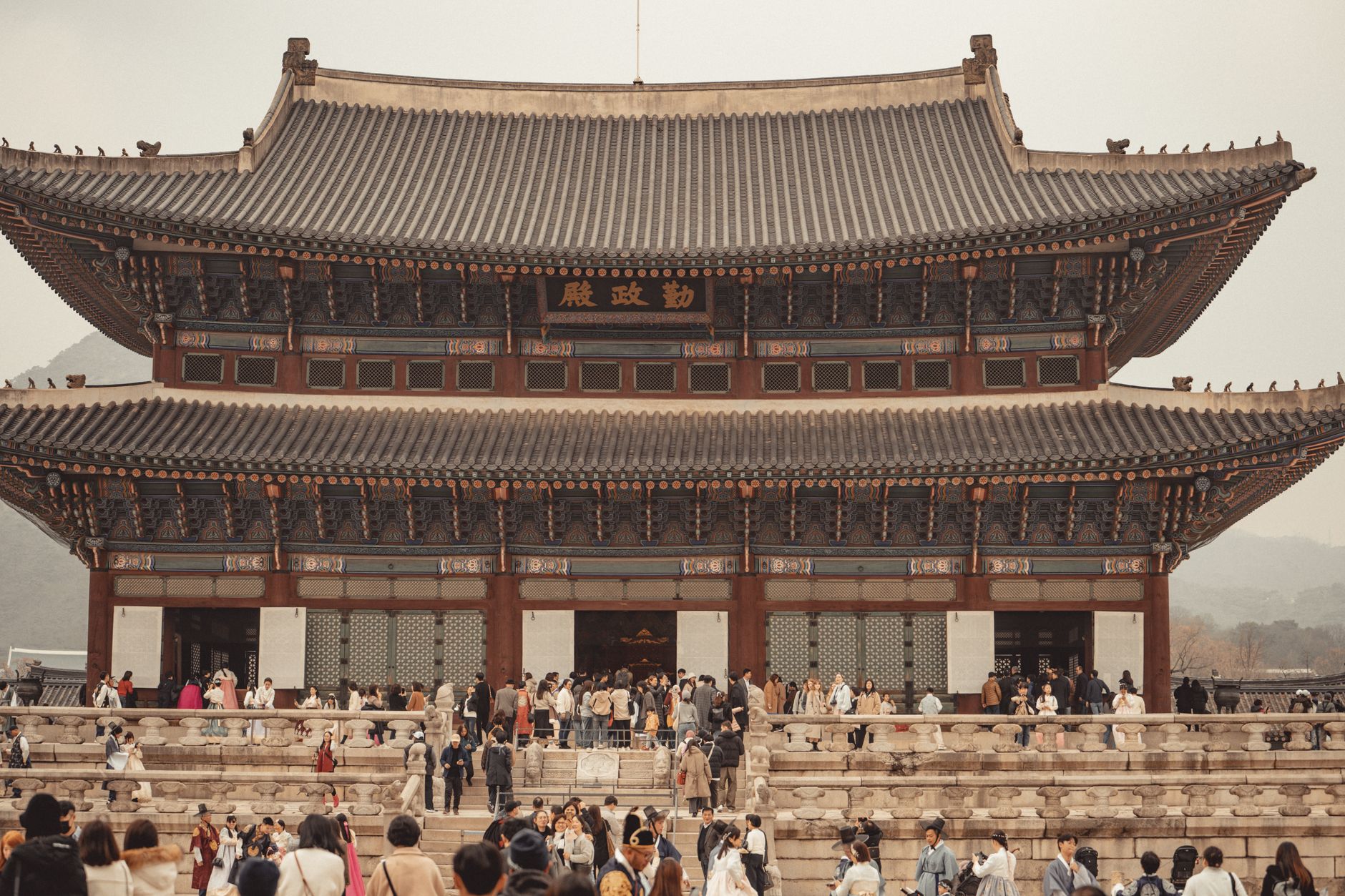
Discover the majestic Gyeongbokgung Palace, a top tourist attraction in Seoul, filled with visitors.
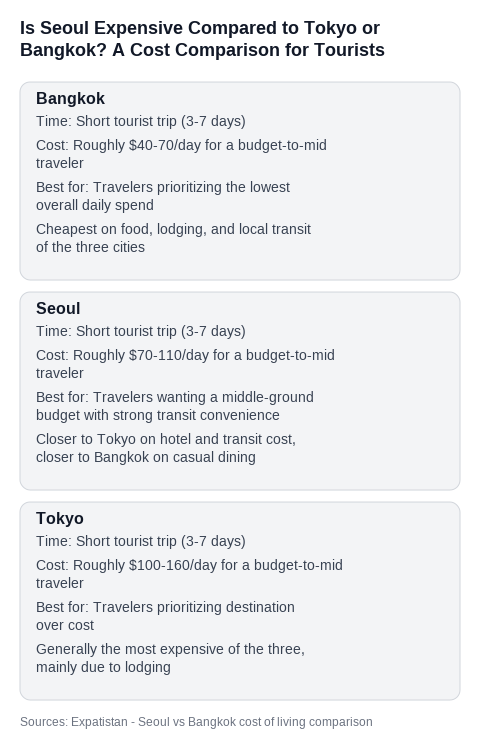
Is Seoul Expensive Compared to Tokyo or Bangkok? A Cost Comparison for Tourists
The size of the gap matters as much as the order: Bangkok to Seoul is usually a bigger jump than Seoul to Tokyo, which means travelers choosing between Seoul and Tokyo on cost alone often find the difference smaller than expected, while travelers choosing between Seoul and Bangkok will feel a more noticeable budget difference.
Daily Budget by Category: Seoul vs. Tokyo vs. Bangkok
Here’s how a single day breaks down for a budget-to-mid-range independent traveler in each city, covering a bed, three meals (mostly local/casual, one mid-range), and local transit:
- Bangkok: roughly $40-70/day. A hostel dorm bed or budget private room runs $8-25, a day of mostly street food and casual Thai restaurants runs $8-15, and local transit (BTS/MRT plus the occasional short taxi) runs $3-6.
- Seoul: roughly $70-110/day. A hostel dorm bed or budget guesthouse runs $15-25, a day mixing convenience-store meals, casual Korean restaurants, and one slightly nicer meal runs $20-35, and local transit on the subway runs $4-7. For a full category-by-category breakdown specific to Korea, see a full daily budget breakdown for independent travel in Korea.
- Tokyo: roughly $100-160/day. A hostel dorm bed or capsule hotel runs $25-40, a day of casual ramen, conveyor-belt sushi, and convenience-store food runs $25-40, and local transit on the subway/JR lines runs $6-10.
These ranges assume a traveler staying in hostel-to-budget-hotel accommodation and eating mostly casual local food rather than fine dining, which is the realistic baseline for most short-trip independent travelers comparing these three cities.
Lodging: Hostel to Mid-Range Hotel, City by City
Lodging is usually the single biggest source of the cost gap between the three cities, and it widens as you move up from hostel to hotel tier:
- Hostel dorm bed: Bangkok roughly $8-15/night, Seoul roughly $15-25/night, Tokyo roughly $25-40/night.
- Budget private room (hostel or guesthouse): Bangkok roughly $20-35/night, Seoul roughly $35-55/night, Tokyo roughly $50-80/night.
- Mid-range hotel (3-star equivalent): Bangkok roughly $40-70/night, Seoul roughly $70-110/night, Tokyo roughly $120-180/night.
The Tokyo-to-Seoul gap on mid-range hotels (roughly $50-70 a night) adds up quickly over a week-long trip, which is one of the clearest reasons Tokyo trends more expensive overall even when food costs are closer between the two cities.
If you’re deciding where to stay in Seoul specifically, see where to stay in Seoul as a first-time visitor for neighborhood-level guidance.
Food Costs: Street Food, Casual Dining, and Convenience Stores
Food is where the three-city gap narrows the most, especially between Seoul and Tokyo. A bowl of Thai street food or a plate from a Bangkok food stall typically runs $1-3, well below equivalent casual meals in either Seoul or Tokyo.
A casual Korean meal (bibimbap, a bowl of guksu, a bulgogi set) in Seoul typically runs $6-10, and a casual bowl of ramen or a conveyor-belt sushi meal in Tokyo typically runs $7-12, which puts Seoul and Tokyo close together on this specific category even though Tokyo is more expensive overall once lodging is factored in.
Convenience store food (triangle kimbap, onigiri, pre-made sandwiches) runs roughly $1.50-4 in both Seoul and Tokyo, essentially tied, and a notch above Bangkok’s cheapest street-food equivalents.
Local Transit: Subway and Taxi Costs Compared
Local transit follows the same Bangkok-cheapest, Tokyo-most-expensive order, but the absolute numbers are small enough per ride that the real cost difference shows up over a multi-day trip rather than any single trip:
- Single subway/metro ride, city center: Bangkok (BTS/MRT) roughly $0.50-1.20, Seoul roughly $1.10-1.40, Tokyo roughly $1.50-2.20.
- Short taxi ride (around 2-3 km): Bangkok roughly $1.50-3, Seoul roughly $4-6, Tokyo roughly $6-10.
Seoul’s subway pricing is close enough to Bangkok’s upper range that frequent short-hop tourists won’t feel a dramatic difference on transit alone, while Tokyo’s taxi fares in particular are noticeably higher than either city, which pushes budget-conscious tourists in Tokyo toward relying on the subway more heavily than they might in Seoul or Bangkok.
A transit card is worth getting in any of the three cities, and in Seoul specifically the choice between card types affects your total cost; see which transit card actually saves you money in Seoul for the breakdown.
Tourist-Specific Spending: Entrance Fees, Tours, and Shopping
Beyond lodging, food, and transit, the spending categories tourists actually hit, palace and temple entrance fees, guided tours, and souvenir shopping, also follow the same general ordering, though the gaps are smaller here than in lodging:
- Major palace/temple entrance fee: Bangkok’s major temples typically run $5-15 for foreign-visitor entry, Seoul’s main palaces typically run $2-4, and Tokyo’s major temple grounds are frequently free to enter with smaller fees for specific inner buildings or gardens. This is one category where Seoul can actually come out cheapest of the three, since several of its most-visited palaces charge a lower flat entry fee than Bangkok’s major temple complexes.
- Half-day guided tour: Bangkok roughly $15-30, Seoul roughly $25-45, Tokyo roughly $35-60.
- Casual souvenir shopping (small gifts, snacks, inexpensive clothing items): Bangkok’s markets tend to run cheapest per item, Seoul’s shopping districts sit in the middle, and Tokyo’s equivalent shopping areas tend to run highest, consistent with the overall cost pattern, though specific deals and sales can shift this on any given day.
The Bottom Line: Which City Is Actually Cheapest for Your Trip
Putting the categories together, the clear ranking for a short tourist trip is: Bangkok cheapest, Seoul second, Tokyo most expensive. The gap from Bangkok to Seoul is the larger of the two jumps, driven mainly by lodging and food costs, while the gap from Seoul to Tokyo is smaller and driven mainly by lodging, since several food and transit categories land close together between the two.
If your main goal is stretching a limited budget as far as possible, Bangkok wins. If you want Seoul’s mix of convenience, transit, and food cost without Tokyo’s higher lodging prices, Seoul is the middle-ground choice.
If cost is a secondary factor to the destination itself, Tokyo’s higher daily budget requirement is the trade-off to plan for rather than a reason to avoid it.
Sources: Expatistan - Seoul vs Bangkok cost of living comparison, Numbeo - Cost of Living Comparison, and Seoul Metro (Seoul Transportation Corporation) fare information (checked 2026-10-12).