From Narita Airport, take the Keisei Skyliner if your hotel is in Ueno, Asakusa or anywhere on the east side of Tokyo, take the JR Narita Express (N’EX) if you are staying near Tokyo Station, Shinjuku or Shibuya, and take a direct airport bus if you have heavy bags, small children or a hotel that sits right on a bus stop. The Skyliner is the fastest rail link, reaching central Tokyo in as little as 36 minutes and Keisei Ueno in as little as 41 minutes, at a one-way fare of 2,580 yen (checked 2026-10-26).
The choice gets easier once you know where you sleep and how much you carry. The sections below work through both.
The three options side by side
| Option | Where it goes | Fastest time | One-way fare | Transfers for most hotels |
|---|---|---|---|---|
| Keisei Skyliner | Nippori and Keisei Ueno | 36 min to central Tokyo, 41 min to Keisei Ueno | 2,580 yen (1,280 yen fare + 1,300 yen Skyliner ticket) | None for Ueno; one for Asakusa or west Tokyo |
| JR Narita Express (N’EX) | Tokyo Station and western hubs on JR lines | Check JR East’s timetable | Check JR East’s current fare | Often none for Tokyo Station, Shinjuku, Shibuya |
| Direct airport bus | Major stations and some hotels | Depends on traffic | Check the operator’s fare page | None if your hotel is a stop |
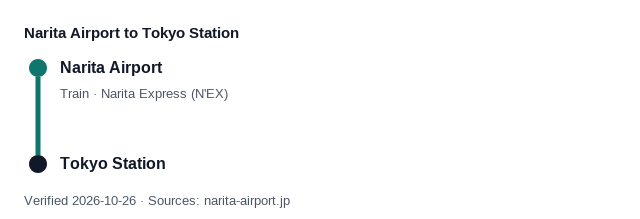
Narita Airport to Tokyo Station. Verified 2026-10-26 from official sources.
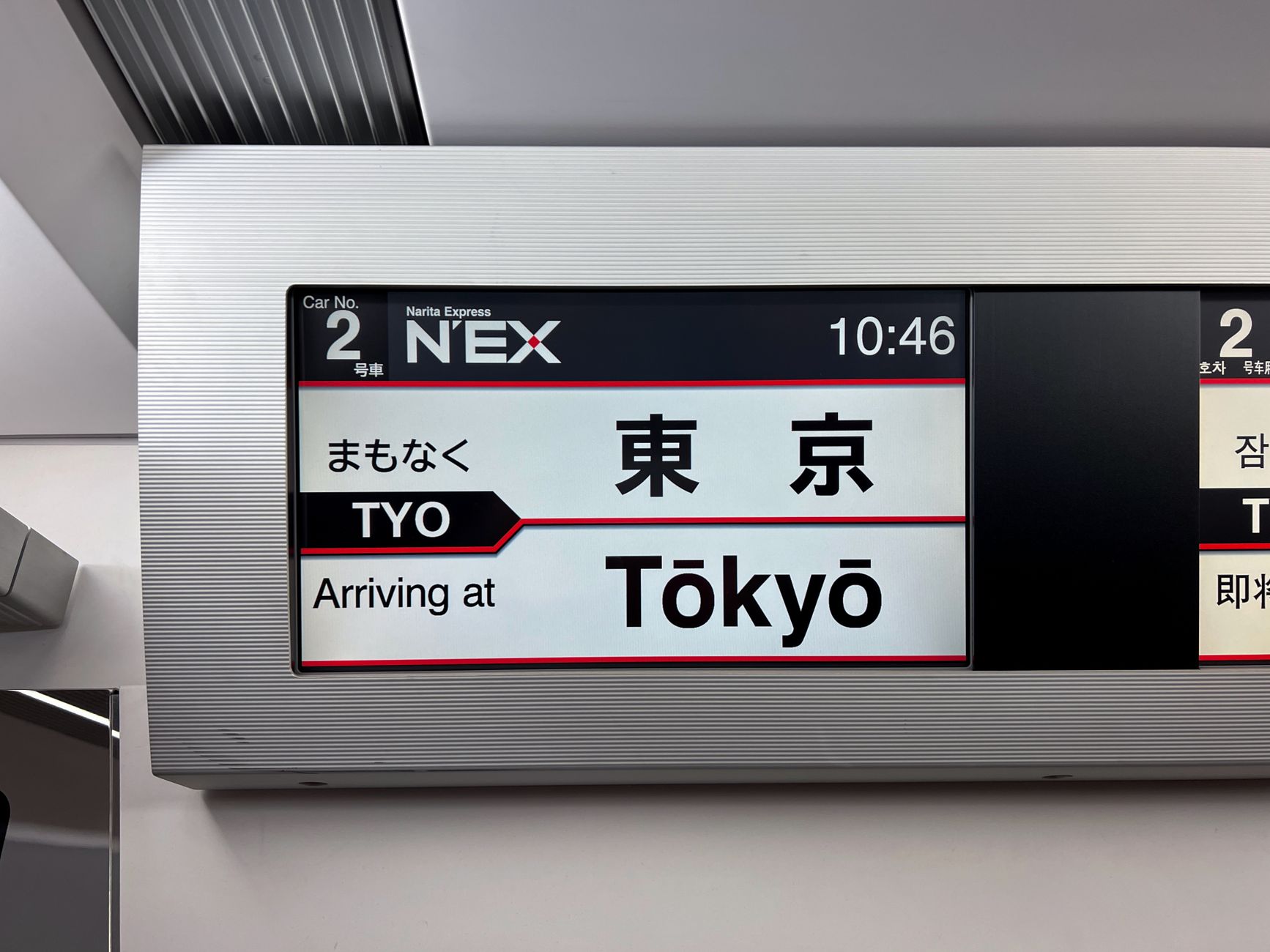
Close-up of Narita Express display showing arrival at Tokyo station.
Skyliner figures come from Keisei’s official Skyliner site and FAQ (checked 2026-10-26). For N’EX and bus fares, use the operators’ own pages on the day you book, because those prices are not repeated here without an official check.
Pick by where your hotel is
Start with the station closest to your hotel, not with the fastest train.
- Ueno, Ueno Park, Okachimachi area: Skyliner to Keisei Ueno. You walk out of the station with no change of train.
- Nippori, Yanaka, Asakusa side: Skyliner to Nippori or Keisei Ueno, then a short connection on JR or the subway.
- Tokyo Station, Marunouchi, Ginza edge: N’EX is usually the simpler ride, because it arrives on JR tracks at Tokyo Station.
- Shinjuku or Shibuya: N’EX avoids a transfer for many trains. The Skyliner plus a JR transfer at Nippori is the other route and needs one change with bags.
- Shinagawa, Shimbashi, Nihombashi: Keisei lists its Access Express as a direct connection from these three stations, which suits travelers who do not want the Skyliner’s Ueno ending.
- A hotel that appears on a bus route: the bus drops you at the door, which beats any train once you count the walk from the station.
Real door-to-door time after you land
The train time is only one part of the trip. Several steps come before you reach a platform:
- Leaving the plane and walking to immigration, which can take a while at a far gate.
- Immigration and customs lines, which change with how many flights land together.
- Waiting at the baggage belt.
- Buying or collecting a ticket, then finding the right platform in the basement station.
- The ride, then the walk or transfer from the arrival station to your hotel.
A 41-minute Skyliner ride can turn into a much longer afternoon if steps 1 to 4 run slow, so book any timed train with a margin. Reserved-seat trains run on a schedule, so a delay at the baggage belt can mean waiting for the next departure. Check Keisei’s timetable on its Skyliner site and JR East’s N’EX timetable before you fly, and note the next two departures after your landing time rather than one.
Late arrivals and first trains of the day
Late evening and very early morning are where the plan most often breaks. Train frequency drops at night, and the last limited express can leave before your bags arrive.
- Before you fly, look up the last Skyliner and last N’EX departure for your arrival day on the official timetables, since timetables are revised from time to time.
- If you miss the last Skyliner, Keisei still runs other services on its lines; its Skyliner site lists the Access Express and the Rapid Limited Express and Limited Express with their own fare tables. They take longer than the Skyliner, but they keep you on rails.
- If trains are finished, a taxi or a hotel near the airport is the practical fallback. Keisei sells a Keisei Skyliner & Teito Taxi package, which pairs the train with a taxi ride at the Tokyo end and helps when the final leg is the problem.
Writing these departure times on paper or in an offline note matters, because a phone that has not connected yet is no help at the arrival hall.
Heavy bags, kids and first trips abroad
Transfers are where heavy luggage hurts. Every change of train means lifting cases onto escalators or hunting for elevators in a crowded station.
The Skyliner works well with bags only when your hotel is at Ueno or a short taxi ride from it. If the plan needs a change at Nippori onto the JR Yamanote Line toward Shinjuku or Shibuya, that change happens on busy platforms, and with two large cases and a child it is the hardest part of the whole journey. For a first trip to Japan, a route with zero transfers is worth a slower ride.
Two ways to cut the load:
- A direct airport bus loads your suitcases underneath and drops you at a station or hotel stop with no transfers at all.
- Keisei’s Hands-Free Travel with Skyliner service lets you leave heavy luggage at the airport for same-day delivery to your accommodation, so you ride the Skyliner carrying only a day bag.
Group, round-trip and combo costs, worked out
Assumptions: adult fares only, the Skyliner fare of 2,580 yen one way, and the Tokyo Subway Ticket prices from March 14, 2026 (24 hours ¥1,000, 48 hours ¥1,500, 72 hours ¥2,000).
- Two adults, one way: 2 x 2,580 yen = 5,160 yen.
- Four adults, one way: 4 x 2,580 yen = 10,320 yen. At this size, compare the total with a taxi quote or the Skyliner & Teito Taxi package, because a group ride can close the gap.
- Paying the base fare with an IC card: Keisei lists the IC base fare at 1,267 yen, so 1,267 yen + 1,300 yen = 2,567 yen, a small saving over the 2,580 yen paper fare.
- Round trip plus a 72-hour subway ticket bought separately: 2 x 2,580 yen = 5,160 yen, and 5,160 yen + 2,000 yen = 7,160 yen.
The Keisei Skyliner & Tokyo Subway Ticket bundles the Skyliner with 24, 48 or 72 hours of subway rides, and its 2026 versions are priced from ¥3,100 to ¥6,100. Match the version to your plan (one way or round trip, and how many hours), then set its price against the separate total above.
If the bundle is lower, buy it; if your Tokyo days lean on the JR Yamanote Line instead of the subway, the separate tickets are often the better fit. Keisei also sells a Skyliner Discount Ticket from Narita Airport to Ueno, so check that page when you book.
Japan Rail Pass holders
N’EX is a JR East train and the Skyliner is not, so the Skyliner always costs extra on top of a rail pass. If you hold a Japan Rail Pass or a JR East regional pass, check on the official pass page whether your pass covers N’EX reserved seats before you pay for a ticket. If it does, N’EX is usually the natural first ride, especially toward Tokyo Station or Shinjuku.
Booking and getting connected
Keisei sells Skyliner e-tickets and seat reservations through its official site, and JR East sells N’EX tickets through its own channels. Buying ahead fixes the seat but not the landing time, so choose a departure with a margin.
Mobile data on arrival helps with timetables and maps. If you are also visiting Korea, see which SIM or eSIM plan works for Korea and Japan on the same trip.
For the same airport question in Seoul, read how to get from Incheon Airport to Seoul by AREX, bus or taxi, and for overall costs there is a comparison of Seoul, Tokyo and Bangkok prices.
Skyliner fares and times were checked on 2026-10-26, and Tokyo Subway Ticket prices on 2026-10-24. Prices and timetables may change, so check the official Keisei and JR East pages before you travel.