From Kyoto Station, take the JR Nara Line to JR Inari Station. Kyoto’s official travel guide puts the ride at about 9 minutes, and the station sits next to the shrine’s main approach. The Keihan line is the better choice only when your day starts around Gion-Shijo, because that is the starting point the official route is written for.
Pick the train by where you start
The decision comes down to your starting point, not to which line sounds more scenic. This table uses the two official Kyoto travel pages (checked 2026-11-14). Fares are not printed here because they change; use the official fare pages linked below the table.
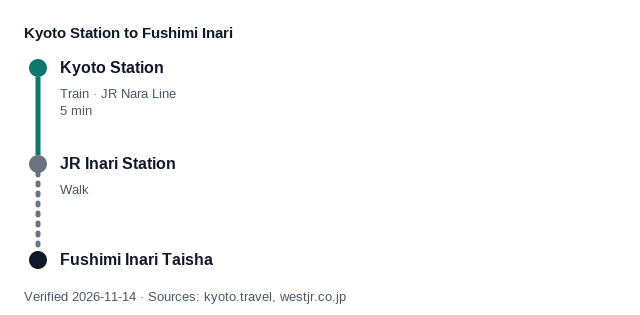
Kyoto Station to Fushimi Inari. Verified 2026-11-14 from official sources.
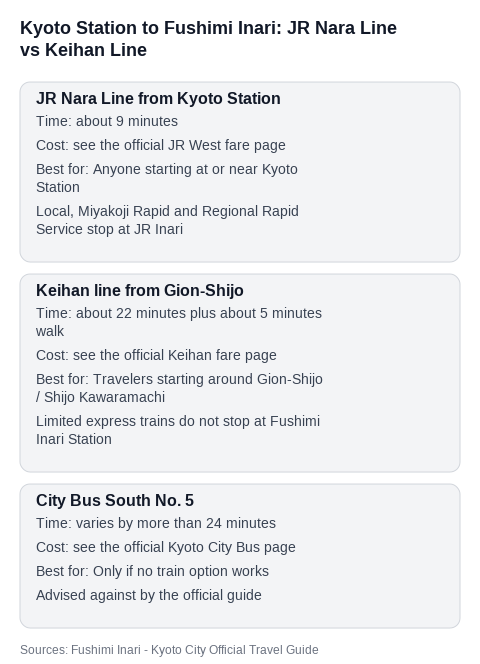
Kyoto Station to Fushimi Inari: JR Nara Line vs Keihan Line
| Starting point | Line and station | Ride time | Walk to the main approach | Trains that stop |
|---|---|---|---|---|
| Kyoto Station | JR Nara Line to JR Inari Station | about 9 minutes | Large red torii gate is visible as you exit; continue east | Local, Miyakoji Rapid, Regional Rapid Service |
| Gion-Shijo (Shijo Kawaramachi) | Keihan line to Fushimi Inari Station | about 22 minutes | about 5 minutes east | Limited express trains do not stop |
For fares, use the JR West official site and the Keihan official site and look up the station pair on the day you travel. Both operators also publish timetables there, which is where first and last trains should be checked, since the Kyoto travel pages do not list them.
From Kyoto Station: the JR Nara Line
This is the practical choice from Kyoto Station. Go to the JR Nara Line platform, board a train toward Nara, and get off at JR Inari Station, the first stop that matters for the shrine. The official guide gives about 9 minutes for the ride.
The guide does not state how often trains run, so do not plan around a fixed interval. Check the live departure board at Kyoto Station or a route app instead (a route app needs mobile data, and which SIM or eSIM plan works for a Korea and Japan trip is covered separately), and just take the next Nara Line train that stops at Inari.
Which trains stop at JR Inari Station
The rule for boarding is simple. Kyoto’s official travel guide says that all rapid trains such as the Miyakoji Rapid and the Regional Rapid Service, as well as local trains, stop at JR Inari Station. So any of those three train types works for this trip.
If you see a different rapid-type service on a display or in a route app that does not appear in the official list, do not assume it stops. Check the stop list on the platform display or in the app before you board. If you are unsure, a local train is the safe choice, because local trains are listed as stopping there.
Walking to the main torii from JR Inari
After you exit JR Inari Station, you can see the large red torii gate and the main approach straight away. Continue east. The official page does not give a walking distance or minutes from this station, so allow a short walk and expect crowds around the approach in busy periods.
When the Keihan line makes sense
The Keihan route in the official guide starts at Keihan Gion-shijo Station (Shijo Kawaramachi), not at Kyoto Station. If you are staying or sightseeing around Gion and Shijo, a direct Keihan ride to Fushimi Inari Station takes about 22 minutes, which can be simpler than going back to Kyoto Station first.
If you start at Kyoto Station, the official route uses the JR Nara Line instead, so there is no need to add a transfer just to use Keihan. Check the Keihan fare page before you go, since the transfer cost depends on where you begin.
One detail matters on Keihan: limited express trains do not stop at Fushimi Inari Station. Board a train type that stops there, and check the stop list before boarding.
The Keihan walk is different from the JR walk
From Fushimi Inari Station, the official guide says to walk east for about 5 minutes. The route passes a temple town with souvenir shops and restaurants, crosses the Inari Bridge and the JR line, and then reaches the main approach. So on this route you walk toward the shrine through the town, while from JR Inari the torii gate is visible as soon as you leave the station. The official page does not describe station exits, so follow the signs and the eastward route it describes.
Bus and taxi as fallbacks
The bus is a weak fallback. Kyoto’s official guide advises avoiding City Bus South No. 5, because its travel time can vary by more than 24 minutes. Road traffic is the reason a short train ride beats it.
The official pages do not mention taxis, so there is no official time or cost to quote here. If you choose a taxi, check the fare with the driver or the taxi company, and keep the trains as your main plan. If you are planning a longer trip that also includes Korea, this cost comparison of Seoul, Tokyo and Bangkok helps with daily budgeting.
Worked check: which route to choose
Using the official figures above (checked 2026-11-14): from Kyoto Station the JR route is about 9 minutes of riding, so 9 minutes of riding is the whole journey apart from the walk from JR Inari. From Gion-Shijo, Keihan is about 22 minutes of riding plus about 5 minutes of walking, so 22 + 5 = 27 minutes door to door from the platform, excluding waiting time. Waiting times are not given in the official pages, so check live departures.
Before you go
- Check fares on the official JR West or Keihan pages for your exact stations.
- Check first and last trains on the operator timetables, since they are not listed on the Kyoto travel pages.
- Board a Nara Line train that stops at Inari: local, Miyakoji Rapid or Regional Rapid Service.
- Avoid City Bus South No. 5 as a plan A.
- If a coin locker matters for your bags, look for current locker information at your departure station, since the official pages do not confirm lockers near the shrine.